On Junque Sacks

It’s time to address one of the great mysteries of womanhood.

Why do so many women feel compelled to buy a lot of purses?

“Aha!” You say. “But I only carry this _____ one.”

Exactly! We buy at least two, frequently many more, sacks designed for carrying our junque. We justify the purchases all kinds of ways: colors, sizes, seasons, years, materials, patterns, or designers/brands. And yet… there is only one.

We may even go through phases of purchasing a brand, color, designer, or material. And yet!

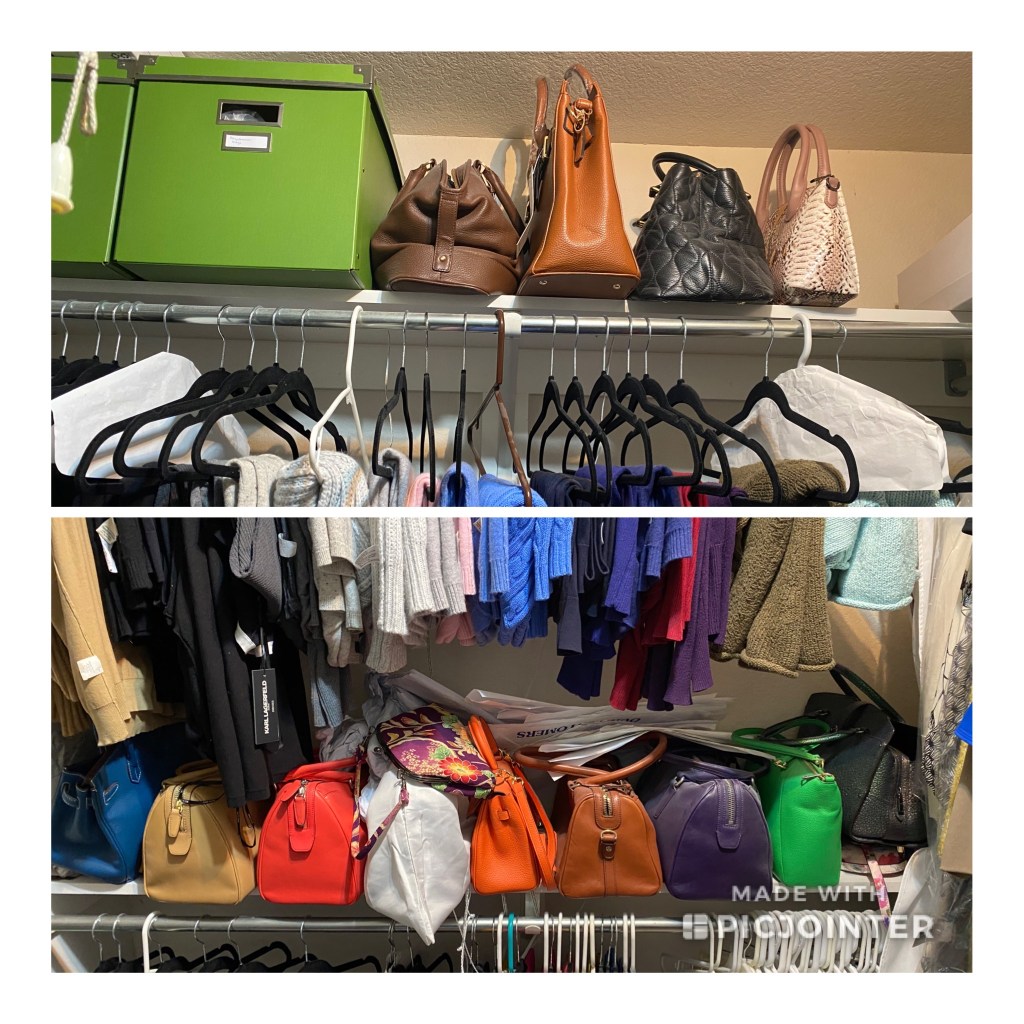
Here is a messy closet view of mine:

My babies.

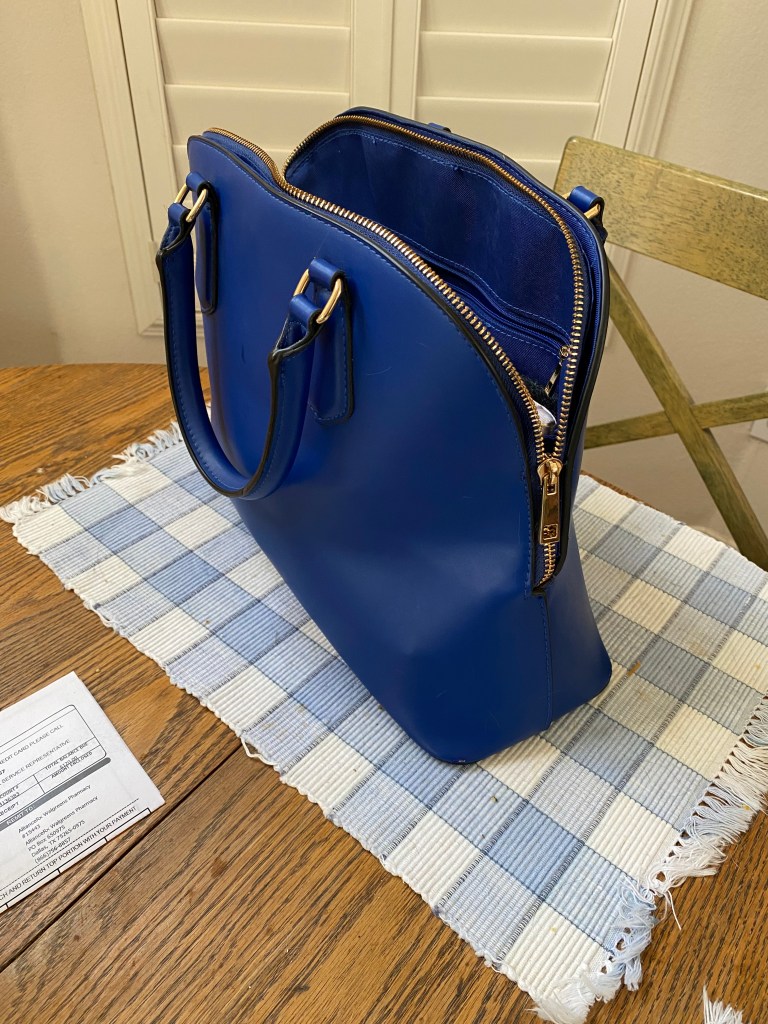
However, here is the purse I carry day-to-day, usually filled to capacity with lunch, sodas, and journal in addition to the usual occupants:

My keys are somewhere in here.

Made of PVC, purchased from a resale site (originally from Target), @$12.99. Blue Magic Marker covering the dings in the pleather.

Why, why, why?

Do I care what it says about me to judging onlookers?

No. It has a shape I’m drawn to, and blue is a counterpoint to most of my clothing colors.

I don’t so much consciously choose this one, I just don’t have to think when I pick it up to go somewhere. And that’s all she wrote.

Finding out about ADHD

The assistant put me on a room with a laptop, and instructed me to try to finish the computerized test in 30 minutes. There was a helpful timer on the other desk.

It was pretty easy. You just clicked when you saw certain shapes. As you progressed, the shapes became more various and appeared more quickly.

Then I noticed the music. I could hear that the assistant outside my testing room playing rock music. Pretty low, but increasingly loud, which I had no trouble hearing. As the puzzles got harder and the timer wound down, she played it louder. This test was a big deal for me.

I got up, opened the door, and said, “Would you mind turning it down?” I knew she heard me, but didn’t acknowledge me. Maybe there was a psychosocial aspect to the test.

I quickly sat down and tried to regain my concentration as the graphics appeared. They were faster. I thought I could match shapes pretty quickly, but the speed was faster than i could register. And her music was even louder!

I got up, opened the door, and protested again. Still no response. What was she doing on her computer?

With 2 minutes to go and the shapes quickly overlapping each other, I put my head in my hands and gave up.

When I talked to the doctor, I knew his results were probably bad. “But,” I protested, “this assistant outside the room kept playing music while I was trying to concentrate.”

“She wasn’t playing music,” he said. “It was the test you heard.”

Yep, 30+ years past my last schooling, I was diagnosed with ADHD. That explains a lot. And I had thought the whole time it was the depression making me unable to think.

Peonies

The day before the wedding, I stopped at the bodega outside our address and allowed myself a moment of bliss in smelling all the flowers. I bought a bottle of Prosecco and a bundle of 5 pink peonies, their scent as present as the promise of bubbles and happiness.

The Professor and I got up like any morning on Bloomsday, June 16, and dressed. We took a taxi to his mother’s apartment, where she gave me an antique Hermes scarf and a gold circle pin. I gave her a peony from my small Saran-wrapped bouquet to wear. We fumbled with securing it to her jacket. Then we set out for Canal Street.

At the courthouse, we sat on folding chairs beside the restroom. Women passed to and from in floor-length white dresses, and the door squeaked every time it opened or closed. The Professor wore an old but beautiful gray suit and his Church’s shoes. I wore the new white linen suit I bought at Saks and nude pumps.

His mother commented that there were a lot of brides around. The Professor commented that we didn’t see any grooms.

After the wedding, we dropped off his mother, ate at a museum’s cafe, changed to our everyday clothes, and got back to work on our books. The flowers were already fading, and the Prosecco was saved for a later day that never happened.

Brain Fog

So I’m sitting at my work desk, trying to pay enough attention to my subject to say anything clearly. And all I get is: Static.

The subject is a robot – and it’s actually a pretty interesting machine – I can register that much – but my mind just says ……bleep…… I go sleepy now.

Why can’t I come up with two sentences about this subject? Or for that matter, anything?

It must be brain fog. I’ve never been absolutely wordless about anything. But on a complex subject that requires consideration and reasoning, I come up with nothing.

Is it the chronic depression? Worse, dementia? Maybe it’s a leftover from COVID – brain fog. And that, we know, does not go away easily.

Less happy

It’s been 4 months since I finished TMS. I use a mood tracker, Daylio, to keep track of mood. I’m also in a TMS group on Facebook. A lot of people there say that the effect of TMS wears off and that they need boosters or a second round.

I guess it’s either wearing off, or my stressors have increased.

The most specific stressor is having work (and income). Either I don’t have it or I have problems getting it. My last job paid a lot of money. But the group lead didn’t like me and was working toward firing me. I quit in order to avoid that. Of course, I also don’t get unemployment as a result. But right before quitting, I contacted my previous employer to ask if I could come back to finish the work I did there (contract). They let me, and I’ve been there 2 months. Pure luck. Only now, it’s a struggle to get up and go in, and I frequently make excuses to come in late, leave early, or sick out. I’m embarrassed about it. I think, if only they could know what’s going on in my head, they might understand. It’s not lack of work ethic, it’s depression.

Recently, I reread a Martha Beck book called “Finding Your Way In A Wild New World.” It was published 9 years ago, but stands the test of time. The gist is that in our new world, the personal has become the professional. She (Martha) asks, How have you been to hell, and how did you find your way back? People are willing to pay for your hel(l)p.

All of this is to say, depression has been my hell. And I thought TMS was my way back. But maybe not.

Headaches

I’m starting to get some during and after treatment. Even the next day. Got one now. I take Naproxen. It does some good.

…Found out that TMS is not a cure. Many people repeat it. I haven’t noticed any change in mood or state of mind, so I don’t see that happening. Also my copay is $2,500 over the course of 5 months, and I make $2,800 a month. Who knows if insurance would pick up the rest of the tab for another go-around.

My care provider is a middle-aged woman who quit dyeing her hair – I like her for that – but otherwise tacit. I don’t know her story and probably won’t. But she asks all about mine: Complicity with meds, number of antidepressants I’ve “failed” (the technical term), etc. All the questions start to feel a little invasive.

It’s hard to work after a treatment. I’m working today ( Saturday) after having done nothing after Friday’s session. I have a pretty demanding workload, and they know I’m “undertaking a course of treatment,” but they don’t know the complaint. Probably assume it’s cancer, which is a bit more noble than emotional failure and lack of coping skills.

One of my now-distant friends posted that his stint as a voice actor didn’t work out, so he’s “onward and upward.” I don’t personally know how that sentiment feels.

TMS: Day 1

They took a Sharpie and marked the point on my nose, between the eyes, and the top of my forehead.

They put a white knit-fabric skullcap on my head, and then mark more measurements. Next, they put a framework overlay with eyelets in the ”rays.” And start marking through those holes.

I felt: Puzzled. Why were they calling out numbers to each other and entering them in the laptop?

One picked up a large, black figure-8 looking thing on a metal hose and said, “This is the coil we’ll be using.”

I felt: Like that thing is the size of half my head, and I wondered how much power it has.

They explained that they’re going to apply the coil at the points they’ve marked, and watch my response. The points they’ve been marking are on my median cortex. When one squeezes the pulse button, the other watches my right hand. I stare at the light switch. I hear a buzz, then my 4th and 5th fingers jump. They rated the response and recorded it. The next pulse, I felt a pulse of movement in my core. I didn’t say anything. it isn’t important, because they didnt say anything about it.

The pulsing and evaluating went on for about 20 minutes until they’ve isolated the most responsive points with the strongest finger jumps. These are the gateways into my mind.

Next, they have me sit in what looks lIke a dentist’s chair, but upright. They place the coil on my cap, steady it, and it begins.

I feel: several rubber band snaps per second, every 3 seconds.
The coil is on the left side of my head, and my eyelid feels like it’s twitching. I ask if they can see my eye move. They say I raise my left eyebrow.

I felt: A headache coming on behind my eyes.

The clicking of the pulses seems to go on and on.

In all, the treatment itself lasts about 15 minutes.

The doctor asks about my tremor, and says I should take 1/2 an Abilify. (Oh, yeah, my tremor.)

This procedure will occur at 6 a.m. every week day for 7 weeks. Since this is Friday, I’ll be coming back on Monday – a work holiday.

Oh yeah, work. I tell my boss I’m not feeling as well as expected, and want to work from home for the afternoon. Then I come home, turn on the electric blanket, and call my cat. Somebody just zapped my brain with a high-powered electromagnet for 15 minutes. That’s enough work for today.
Xenophobia

In 1989, New York was a gorging city full of people chasing and catching dreams.

One year out of college, I was the admin at a bespoke architecture group. Snow swirled in white pancakes in the updraft across Fifth Avenue, and I stood at an office window entranced by the hustling life and undeniable beauty around me.

Image: Shutterstock

Through the office door came a tightly packed young man who moved like a cat as he crossed to the contractor desk. His gear, all black, was dusted with slush, and he sprayed droplets as he walked. His bicycle was very fine, and I was amazed that he could lift it with 2 fingers to lean up in a corner. He introduced himself as Ko. He explained that he’d come to New York to be a bicycle racer.

One morning, as I walked up Fifth toward the office, jutting like an ice breaker through the cold, a reckless messenger passed me and stopped and hopped off his bike in one motion. Only it wasn’t a messenger, it was Ko. As he passed me he said, “You have a very nice skirt,” and made a curving gesture that I realized was the curve from the small of my back.

We fell in love over the following months, and I eventually moved from my apartment to his little studio on 96th at Second Ave., and then over Christmas became engaged.

I brought him home to meet Mom and her husband, and Dad and his wife. Over the first two days, Mom’s husband, in his 60s, squinted at Ko every time they met in the same room. Soon, Ko reported that he was ill and then missed nearly all meals and activities.

We drove down to meet Dad, who received him coolly. At one moment alone I confronted Dad, who said looked me in the eye over his glasses and said simply, “His parents killed some of my friends.”

After that, a wall materialized between Ko and me that we couldn’t cross. He began drinking lots of vodka every night, and I began to hate his slurring shouts. In June, I returned his olivine engagement ring and left New York to wander down the East Coast states, trying to figure out what I was returning to.

The Good Mother

The weekend of my nephew’s wedding was beautiful and fair in the streets and roads of the Georgia town where it was held.

Photo by fotografierende on Pexels.com

While riding in my parents’ car, my mother suddenly cleared her throat and said, “Wasn’t I a good mother, Jenny, wasn’t I good mother?” Then she repeated, “Wasn’t I good mother, Jenny, wasn’t I good mother?”

I was dumbstruck. All the times she’d put me down, screamed at me to vent her frustrations with other people, stabbed me in the back with the family, and had chosen my brother over me in a family standoff flew through my mind. Could I just tell her what she demanded to hear? And what then? Were all my feelings and observations nothing? Should I force myself to lie, when I’d always been the one to speak the truth, even at her own peril?

I said nothing. My stepfather laughed nervously. My mother shot a look at him, and he stopped immediately. Then she turned to me in the reflection of her window. Of all the times I’d seen her angry or demanding, the deep darkness of this expression was not one I knew.

Could I save the moment? Could I lie, now? Should I list what I’d stored up in my mind as her worst offenses? Then I thought: If you don’t tell the truth now, you never will, and all of your pain from her counts for nothing.

I stayed quiet.

Was my integrity worth all that it subsequently cost me? I still don’t know. I do know that even though that afternoon was sunny and unseasonably warm, some terrible clouds arose over us, never to go away again.

She changed her life insurance to 90% for my brother, 10% for me. She gave all of her expensive jewelry to my sister in law, a flatterer and liar.

Today, I still wonder sometimes whether that moment of self righteousness was worth not being able to pay off my house, or have some of the beautiful jewelry she had collected. I wonder if a lie would have saved our relationship. But I think the relationship was gone the minute I was forced to lie about it.